
Malware analysis is no longer limited to investigating suspicious binaries after an alert fires. In modern attacks, malicious behavior is often introduced earlier, hidden inside dependencies, installation scripts, or build artifacts that appear legitimate. By the time runtime indicators surface, the malware has already moved through development pipelines and into production systems.
Understanding what is malware analysis today requires looking beyond execution and focusing on how malicious code enters software environments in the first place.
What Is Malware Analysis in modern software environments
At a basic level, malware analysis is the process of determining whether software is malicious, how it behaves, and what it is designed to do. Traditionally, this meant reverse-engineering executables or inspecting suspicious files after compromise.
That model no longer holds. Many modern attacks do not rely on a single malicious binary. Instead, they spread through trusted package registries, dependency graphs, and automated build systems. Malware analysis is now used to identify hidden behavior in software that otherwise appears legitimate.
The goal is no longer just classification. It is early detection and containment.
Why Malware Analysis Became Harder
Older malware reused code and followed predictable patterns. Signatures worked. Heuristics worked. Today’s malware is designed to avoid both.
Attackers hide payloads in auxiliary files, test directories, or lifecycle scripts. Execution may be gated by operating system, architecture, or environment variables. In some cases, malicious logic is dormant until it reaches a developer machine or CI runner with credentials.
This means static inspection alone often shows nothing suspicious. Dynamic execution may also fail to trigger behavior if the environment does not match the attacker’s conditions. Malware analysis now requires context.
This shift reflects a broader trend in cybersecurity. Malware analysis is no longer an isolated discipline, it must work alongside other security controls designed to protect modern, distributed, and hybrid environments. As organizations rethink their security posture, understanding how malware analysis fits into the wider cybersecurity landscape is critical, especially for teams supporting hybrid workforces.
Static and dynamic analysis are no longer enough on their own
Static malware analysis still plays an important role. It can reveal obfuscation, unexpected scripts, or inconsistencies between documented functionality and actual code. However, modern malware is frequently engineered to appear harmless when viewed statically.
Dynamic malware analysis improves visibility by observing runtime behavior. But attackers increasingly detect sandbox environments, delay execution, or change behavior based on where the code runs. As a result, many attacks evade both approaches unless analysis extends into real build and installation workflows.
Malware Analysis Tools and the software supply chain
This is where malware analysis tools have shifted focus. Instead of analyzing isolated binaries, they analyze behavior across the software supply chain.
This includes:
- What runs during package installation
- What files are written during builds
- Whether external runtimes or tools are installed silently
- How dependencies behave over time
Several recent supply chain attacks were identified not because malware crashed systems, but because packages behaved in ways that did not match their purpose. Unexpected filesystem access, credential scanning, or network communication were the only clues.
Malware analysis tools that operate at this level detect threats earlier, before they spread.
Behavioral signals are the primary indicator
Modern malware changes appearance easily. It cannot avoid behavior. Execution of lifecycle scripts, environment reconnaissance, access to credential stores, or attempts to persist inside developer environments are all signals that analysis tools look for. Individually, these actions may seem benign. Together, they form a clear pattern.
Effective malware analysis tools correlate these behaviors across environments and versions, allowing teams to distinguish real threats from normal variation.
Automation with analyst oversight
The scale and velocity of modern software ecosystems have fundamentally changed what effective malware analysis looks like. Development teams routinely consume thousands of open-source dependencies, each with frequent updates, transitive dependencies, and multiple installation-time behaviors. Manual inspection of this volume is not just inefficient; it is impossible.
This is why automation is no longer optional in malware analysis.
Modern malware analysis tools continuously monitor dependency ingestion, installation scripts, and build-time execution across environments. They automatically surface anomalies such as:
- Unexpected lifecycle scripts executed during installation
- Access to sensitive environment variables or credential stores
- Silent downloads of external binaries or runtimes
- Filesystem modifications unrelated to the package’s stated purpose
Automation excels at pattern recognition at scale. It detects deviations from normal behavior across versions, ecosystems, and execution contexts, signals that would be invisible in isolated analysis.
However, automation alone cannot determine intent.
Many legitimate packages perform actions that, in isolation, may appear suspicious. Build tooling, test frameworks, and language runtimes often require filesystem access, environment inspection, or network connectivity. This is where human expertise becomes critical.
Effective malware analysis relies on a clear division of labor:
- Automation identifies the signal: behavioral anomalies, correlations, and deviations
- Analysts interpret the signal: determining whether behavior is malicious, negligent, or expected
Analysts provide the contextual judgment that machines cannot: understanding developer intent, ecosystem norms, and real-world impact. This human-in-the-loop approach prevents alert fatigue while ensuring high-confidence detection of genuine threats.
In practice, the most effective malware analysis programs are not fully automated or fully manual; they are collaborative systems, where automation accelerates discovery, and analysts validate risk before action is taken
Malware Analysis as a preventive control
The most important evolution in malware analysis is when it is applied.
Historically, malware analysis was reactive. Suspicious behavior was investigated after deployment, after compromise, or after indicators of compromise appeared in production systems. At that point, credentials may already be exposed, build environments poisoned, and downstream consumers impacted.
Modern malware analysis shifts this model upstream.
When analysis is applied during dependency ingestion, installation, and build execution, malicious behavior can be detected before it reaches production, or even before developers install the package locally. This transforms malware analysis from an investigative function into a preventive security control.
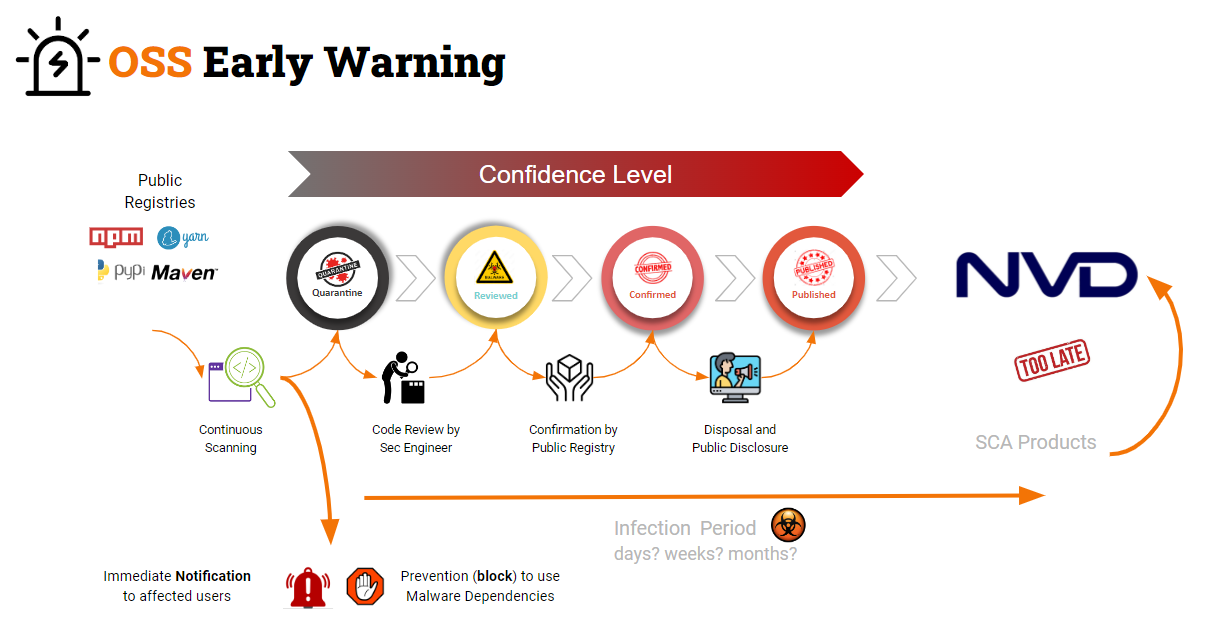
This preventive approach is increasingly critical as attackers target:
- Open-source registries as initial access vectors
- CI/CD systems as high-value execution environments
- Developer machines as gateways to credentials and signing keys
Platforms such as Xygeni apply malware analysis techniques directly to the software supply chain rather than isolated artifacts. Instead of scanning binaries after the fact, analysis is performed on:
- What actually executes during dependency installation
- How packages behave across different environments and versions
- Whether the behavior aligns with the package’s documented purpose
For example, a seemingly benign library may introduce a post-install script that:
- Enumerates environment variables commonly used for cloud credentials
- Accesses SSH configuration directories
- Attempts outbound network communication during installation
Individually, none of these actions guarantees malicious intent. But when correlated across environments, versions, and ecosystems, they form a behavioral pattern that strongly indicates compromise.
By identifying and correlating these behaviors early, preventive malware analysis allows teams to:
- Block compromised packages before installation
- Prevent malicious code from ever executing in CI pipelines
- Stop supply chain attacks before they propagate downstream
In this model, malware analysis is no longer a cleanup activity. It is a gatekeeper, enforcing trust boundaries at the exact point where malware enters modern systems.
Why Malware Analysis Tools are now mandatory?
So, what is malware analysis today? It is not a post-incident activity. It is a continuous control applied to software as it moves through the supply chain. As attackers increasingly target developers, CI systems, and dependency registries, malware analysis tools must operate where malware actually enters. Organizations that treat malware_toggle analysis as an upstream security function are far better positioned to detect, contain, and prevent modern supply chain attacks.
When malware analysis is delayed until runtime, attackers are already operating inside your pipeline. Beware!
For teams evaluating solutions in this space, it’s important to understand how different platforms approach supply chain visibility, behavioral analysis, and prevention. You can check for tools and compare cybersecurity software options here, using an independent comparison of security platforms and alternatives to help identify the best fit for your organization.