
Most startups approach SEO the way they approach everything else: copy what the market leader does. That is precisely why most of them get nothing from it. According to Ahrefs’ study of roughly 14 billion pages, 96.55% of all content gets zero traffic from Google. The web is not short on published pages — it is short on pages that were built to win a specific, winnable search.
For a startup, that is actually good news. SEO is one of the few channels where a five-person company can beat a five-hundred-person company, because the currency is not budget. It is positioning: choosing battles the incumbents are not fighting, and stacking small, compounding advantages — authority, reviews, and content designed around real search demand. Here is the playbook, step by step.
Start With Keywords You Can Actually Win
The single most common startup SEO mistake is targeting the same head terms as the category leader. If an established competitor has ten years of backlinks, you will not outrank them for “project management software” this year, and probably not next year either.
The winnable battles sit lower: long-tail, high-intent queries where the searcher already knows what they want. Comparison queries (“X vs Y”), alternative queries (“X alternatives”), and use-case queries (“time tracking for freelancers”) have a fraction of the competition and a much higher likelihood of converting, because the intent is commercial rather than casual. Backlinko’s analysis of 4 million search results found that keywords of 10–15 words get 1.76x more clicks than single-word terms — specificity is rewarded, not punished.
The discipline that matters here is honesty about difficulty. Before committing to a keyword, look at who currently ranks. If the entire first page is DR 80+ publications, move on. Your first fifty pages should target queries where at least one weak site already ranks — proof the door is open.
Get the Technical Basics Right Once, Then Stop Obsessing
Technical SEO is a threshold, not a ladder: you need to clear it, and clearing it twice earns nothing. Google’s own SEO starter guide covers most of what a small site genuinely needs — crawlable pages, descriptive titles, sensible URLs, and internal links that connect related content.
Where startups actually lose rankings is in self-inflicted wounds shipped during development: client-side rendering that hides content from crawlers, duplicate pages with no canonical tags, orphaned pages no internal link points to. CompareCamp’s rundown of common SEO mistakes made during SaaS design and development is a useful pre-launch checklist, because fixing these after launch always costs more than avoiding them.
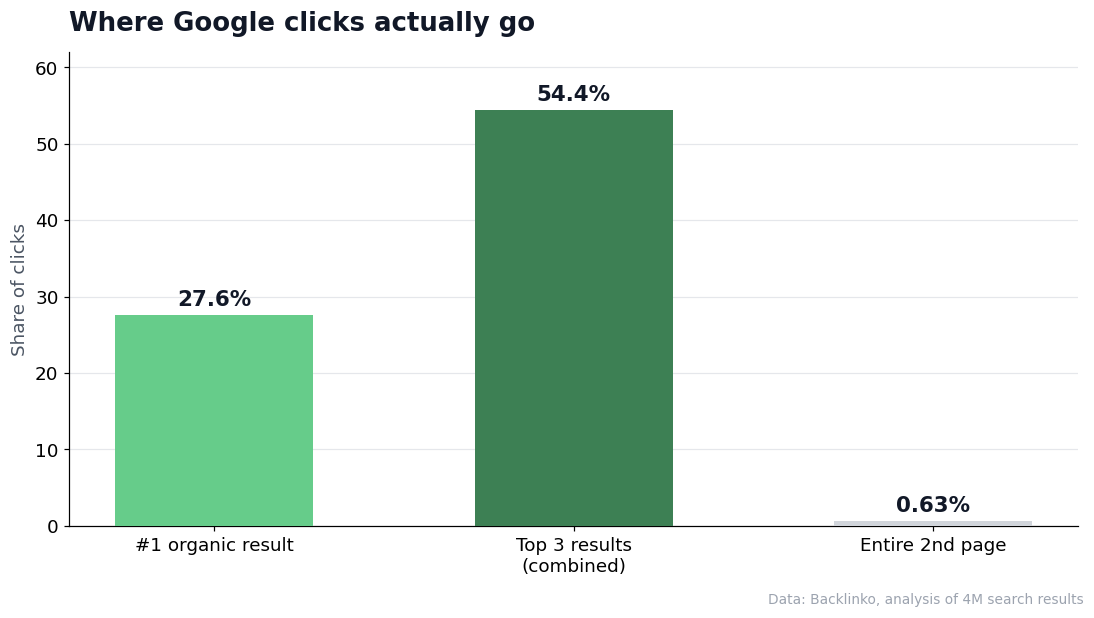
One number worth internalizing before moving on: position matters far more than presence. The same Backlinko study found the #1 organic result takes 27.6% of all clicks, the top three take 54.4% combined, and the entire second page splits 0.63%. Ranking eleventh is functionally the same as not ranking.
Build Early Authority With Directories and Listing Sites
A new domain’s core problem is that Google has no reason to trust it. Backlinks are how that trust gets bootstrapped, and for a startup with no PR budget, the most reliable first source is directories and listing platforms — startup directories, software catalogs, and launch sites that exist specifically to feature new products.
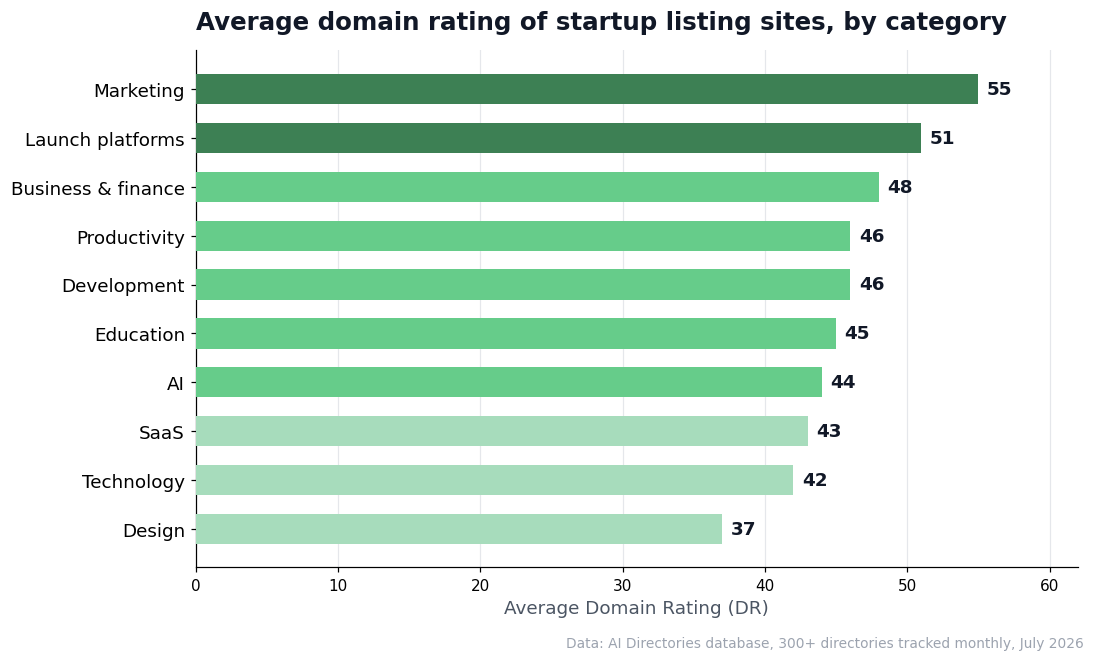
This tactic has a spammy reputation left over from the 2000s, and the skepticism is deserved when it is done indiscriminately. The difference between authority-building and time-wasting is selectivity, and selectivity requires data. An analysis of more than 300 startup and software directories tracked by AI Directories found that average domain ratings vary meaningfully by category: marketing-focused directories average DR 55 and launch platforms DR 51, while general design directories average just 37. A listing on a DR 50+ site with a followed link passes real authority; ten listings on DR 15 sites pass approximately nothing and cost the same afternoon.
Research Findings: Directory Authority by Category
Data source: AI Directories database of 300+ startup and software directories. Key findings:
- Marketing-focused directories: average Domain Rating (DR) 55
- Launch platforms: average DR 51
- General design directories: average DR 37
Implication: A single listing on a DR 50+ domain with a followed link passes meaningful authority. Ten listings on DR 15 sites have negligible cumulative value.
The practical approach: prioritize a shortlist of 20–30 directories by domain rating and link type before submitting anywhere, starting with launch platforms and the highest-authority niche directories in your category. Free listings on strong domains are the best effort-to-value trade in early-stage SEO — treat paid listings on weak domains with suspicion.
Turn Reviews Into a Ranking Asset
Third-party review platforms do two jobs at once. They rank for the commercial queries you cannot win yet — searches like “best [category] software” are usually dominated by review sites, so being listed there is often the only way to appear in those results at all. And they generate the trust signals Google’s systems increasingly reward: real users, real ratings, third-party validation.
The catch for early-stage companies is the cold-start problem — nobody reviews a product with no reviews. It is solvable with process rather than budget: asking at the moment of success (right after a support win or a milestone), making the request personal, and focusing on one platform at a time until it reaches critical mass. CompareCamp has a practical guide on how SaaS startups can get more reviews when just starting out that treats this as the operational problem it is.
Publish Content That Compounds, Not Content That Fills a Calendar
Startup blogs fail because they publish what is easy (announcements, opinion pieces) instead of what is searched. The content that compounds is nearly always bottom-of-funnel: comparison pages, alternative roundups, integration guides, and honest pricing explainers. These pages earn less applause on social media and dramatically more revenue from search.
A useful mental model is that every page should have a job description — one query cluster it exists to win. Pages without a target query are hobbies. For a broader framework on structuring this, CompareCamp’s guide to growing organic traffic through solid SaaS SEO strategies walks through how content, keywords, and site structure fit together for software companies specifically.
The publishing math favors depth over frequency. Five pages that each own a winnable query will outperform fifty pages of general topics — and the fifty-page approach actively hurts, because thin content dilutes how search engines assess the whole domain.
Measure Authority, Not Just Rankings
Rankings fluctuate weekly and can mislead in both directions. The metric that tracks whether your foundation is actually growing is domain authority — the aggregate strength of your backlink profile. It moves slowly, which is exactly why it is honest.
Check it monthly, not daily; a free domain rating checker is enough for this. What you want to see is a steady climb as directory listings, reviews, and content-earned links accumulate. If DR is rising while rankings have not moved yet, the system is working and rankings follow. If DR is flat after six months, the problem is link acquisition — not content, and no amount of additional publishing will fix it.
The Compounding Effect
None of these steps is impressive in isolation. A directory listing is a small win. One review is a small win. One comparison page ranking #4 is a small win. The reason SEO remains the highest-leverage channel for startups is that these small wins do not expire — they stack. The page that ranks this month still ranks next month, while the ad you bought last month is gone.
The startups that win search are rarely the ones that spent the most. They are the ones that picked winnable battles, cleared the technical bar once, borrowed authority systematically, and let eighteen months of compounding do what no budget can buy.
Note: This document references three images from the original article:
- featured-seo-for-startups.png (featured image)
- chart-google-ctr-by-position.png (CTR distribution chart)
- chart-avg-dr-by-directory-category.png (DR by category chart)