
Recruitment involves a series of decisions, from finding potential candidates and reviewing resumes to conducting interviews and making offers. Artificial intelligence can make several of these steps faster, particularly when hiring teams need to manage large applicant pools. However, speed does not always translate into better hiring decisions.
AI can identify relevant skills, organize candidate information, draft interview questions, and reduce repetitive administrative work. It can also overlook qualified applicants, reproduce existing biases, or generate assessments that do not reflect a candidate’s actual abilities. These limitations matter because hiring is not simply a matter of matching keywords to job descriptions. It requires understanding people, evaluating evidence, and deciding who can succeed in a particular role.
The most effective approach is to use AI where it improves efficiency while keeping human judgment involved wherever decisions affect candidates’ opportunities.
Key takeaways
|
Where AI genuinely helps in recruitment
1. Finding candidates and identifying relevant skills
Recruiters often work across multiple job boards, professional networks, and internal databases. Searching these sources manually can consume considerable time, particularly when a role attracts hundreds of applications.
AI-powered sourcing tools can search candidate databases, identify relevant profiles, and surface people whose skills match an open position. Natural language processing can also help identify related skills that do not use precisely the same terminology as a job description.
For example, a recruiter looking for a data analyst might consider candidates with experience in business intelligence, reporting automation, or statistical analysis, even if their profiles do not contain the exact job title.
This can expand the search beyond obvious keyword matches and help recruiters discover candidates they might otherwise overlook. Candidate sourcing and matching tools can also help employers organize potential applicants around specific vacancies, making it easier to identify profiles worth reviewing.
Where a human needs to step in: Recruiters must determine which skills are genuinely necessary and which can be learned on the job. They should also review whether sourcing criteria exclude qualified people because of career breaks, nontraditional career paths, or differences in how candidates describe their experience.
A larger candidate pool is useful only when the search criteria reflect the actual requirements of the role. For hiring teams evaluating AI solutions, understanding which AI tools work in tech hiring and which are just hype can also help distinguish practical recruitment applications from tools that may not deliver meaningful value.
2. Organizing resumes and managing application volume
Resume screening is one of the most practical applications of recruitment automation. When a position attracts hundreds or thousands of applications, reviewing every resume manually can delay the hiring process.
AI-assisted recruitment systems can extract information from resumes, organize applications by skills and qualifications, and help recruiters prioritize profiles for further review. Applicant tracking systems can also centralize candidate records and track progress across hiring stages.
Choosing suitable applicant tracking software can help businesses manage applications more systematically, particularly when several recruiters and hiring managers are involved.
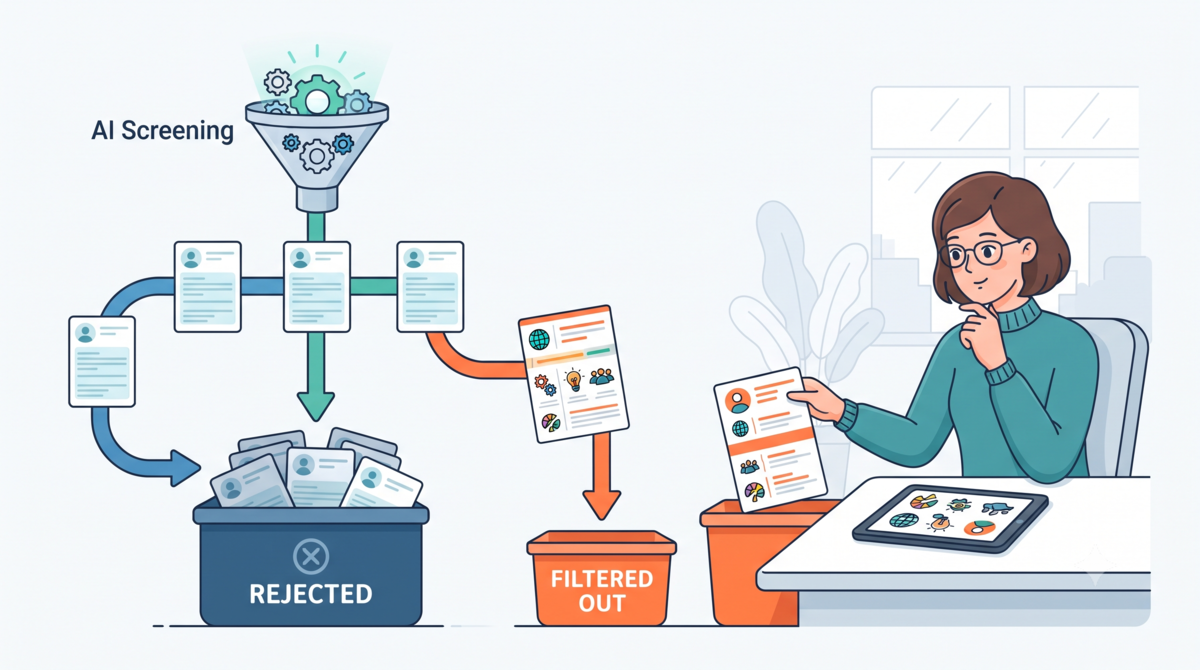
However, screening criteria need careful attention. A system that prioritizes specific degrees, job titles, employers, or career histories may favor conventional candidates even when others possess equivalent skills.
Where a human needs to step in: Recruiters should verify whether the system interprets resumes correctly, especially when applicants use different formats or describe transferable skills in unfamiliar ways. They should review borderline applications and ensure that qualified candidates are not rejected solely because an automated score falls below an arbitrary threshold.
AI should help organize the applicant pool, not automatically determine who deserves an opportunity.
3. Handling repetitive communication and scheduling
Recruitment requires frequent communication. Candidates need application updates, interview invitations, scheduling options, reminders, and answers to routine questions. When these tasks are handled manually, recruiters have less time to focus on candidate evaluation.
AI assistants and recruitment workflow tools can automate scheduling, send reminders, answer common questions, and draft personalized messages. They can also help coordinate interview availability across multiple participants. For job seekers, similar automation can reduce the repetitive work involved in finding suitable roles and submitting applications, particularly when applying across multiple job boards. An AI job application tool can handle parts of this process by finding matching jobs, tailoring CVs, and submitting applications on the candidate’s behalf.
This is a relatively straightforward area for automation when messages involve routine information and the system has access to accurate, approved details.
Where a human needs to step in: Recruiters should handle sensitive conversations, unusual requests, complaints, and situations requiring empathy or discretion. They should also verify messages involving compensation, employment terms, interview outcomes, or changes to the hiring process.
Automating administrative communication should make recruitment more responsive, not make candidates feel that nobody is accountable for their experience.
4. Preparing structured interviews
Interview quality depends partly on asking questions that relate directly to the responsibilities of a role. Yet interviewers do not always use consistent questions or evaluation criteria, particularly when multiple managers participate in hiring.
AI can help generate role-specific interview questions, create competency-based question banks, develop hypothetical work scenarios, and prepare scoring rubrics. It can also help hiring teams align interview questions with the skills identified in a job description.
For example, a customer success position might require questions about conflict resolution, customer retention, and prioritizing competing requests. An engineering position might need questions that assess system design, debugging, and technical decision-making.
AI can provide a useful starting point for building these assessments.
Where a human needs to step in: Hiring managers must verify that questions reflect the actual role and assess relevant competencies. They should remove questions that are unnecessarily personal, ambiguous, or unrelated to job performance. Interviewers also need to consider whether the assessment gives candidates a fair opportunity to demonstrate their abilities.
AI can help prepare the interview, but it cannot independently establish what success looks like in a particular organization.
Where human judgment remains essential
1. Evaluating candidates fairly
AI can compare application information against predefined criteria, but fairness depends on how those criteria are selected and applied. Historical hiring data may reflect past preferences that favored certain backgrounds, qualifications, or career paths. If a system learns from those patterns without appropriate safeguards, it may reproduce them.
Research on fairness and bias in algorithmic hiring highlights why these risks need to be considered when designing and evaluating automated recruitment systems.
Where a human needs to step in: Recruitment teams should review screening criteria, test systems for potential adverse impacts, and check whether decisions disproportionately exclude particular groups. They should also provide a way to review questionable outcomes rather than treating automated recommendations as unquestionable.
The U.S. Equal Employment Opportunity Commission’s guidance on employment tests and selection procedures explains how selection procedures can raise discrimination concerns when they disproportionately exclude protected groups without sufficient justification.
Human involvement does not automatically eliminate bias. Recruiters have their own assumptions and preferences. The objective is to combine appropriate safeguards, measurable criteria, and accountable decision-making.
2. Understanding context that resumes cannot capture
A resume provides a limited view of a candidate. It may describe responsibilities, qualifications, and achievements, but it rarely explains the full circumstances behind them.
Two candidates with similar experience may have developed very different capabilities. One might have led a project independently, while another contributed to a larger team. A candidate with a career break might have relevant skills that are not obvious from a chronological resume. Someone moving from another field might possess transferable experience despite having a different job title.
AI can identify information in candidate profiles, but it cannot reliably reconstruct every missing detail.
Where a human needs to step in: Recruiters and hiring managers should ask follow-up questions, examine evidence of relevant skills, and give candidates an opportunity to explain their experience. They should distinguish between missing information and evidence that a candidate lacks a required qualification.
This is particularly important when assessing career changers, applicants with nontraditional backgrounds, and candidates whose experience does not follow a conventional progression.
3. Conducting interviews and assessing real ability
AI can help prepare interviews, summarize structured feedback, and organize assessment results. However, a polished resume or convincing written answer does not necessarily demonstrate that someone can perform the job.
Candidates may use AI to improve application materials, prepare interview responses, or complete take-home assignments. These uses are not inherently problematic, especially when permitted. The difficulty arises when an assessment measures a candidate’s ability to produce an AI-assisted answer rather than the underlying skill the employer intends to evaluate.
Employers should decide which skills matter and whether AI use is permitted during each assessment.
Where a human needs to step in: Interviewers should ask candidates to explain their reasoning, discuss specific examples, and respond to relevant follow-up questions. For practical assessments, they can evaluate the process behind a result rather than relying exclusively on the final output.
The aim is not to catch candidates using AI. It is to understand what they can actually do, how they make decisions, and whether their capabilities match the role.
4. Making the final hiring decision
AI can consolidate interview feedback, compare candidates against predefined requirements, and highlight areas that need further investigation. These functions can support decision-making, particularly when several interviewers contribute different assessments.
However, the final decision involves more than producing a ranking. Hiring managers must consider the essential responsibilities of the role, the strength of the available evidence, the candidate’s demonstrated capabilities, and any unresolved concerns.
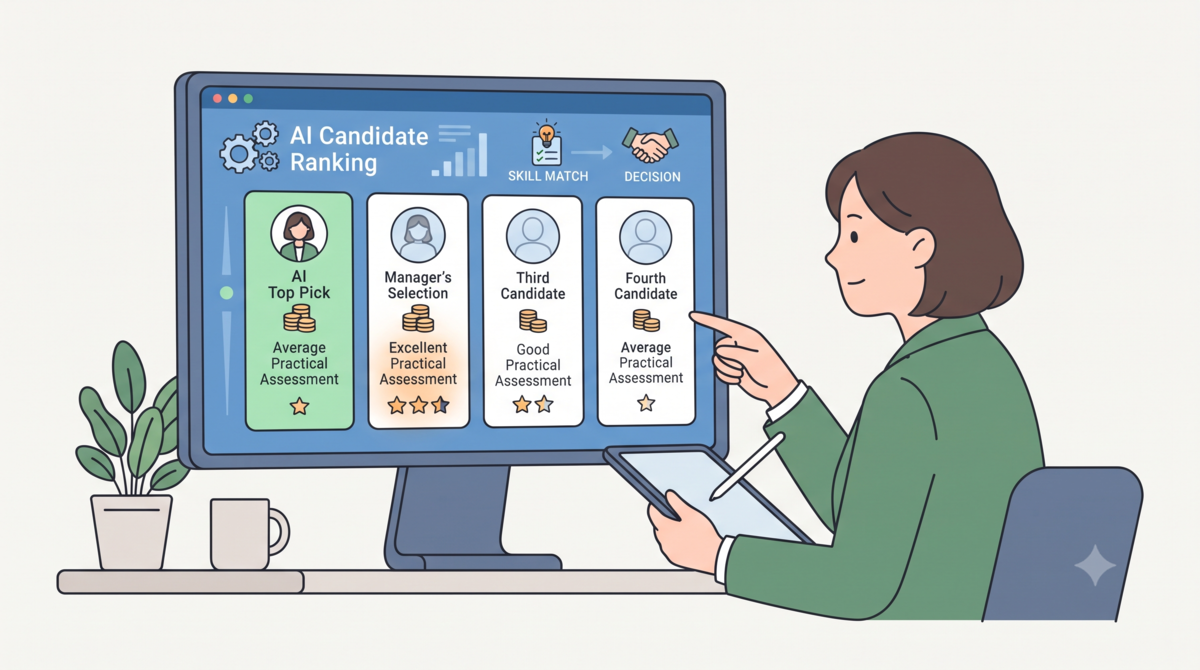
A high automated score should not automatically outweigh strong evidence from a practical assessment. Similarly, a lower score should not automatically disqualify a candidate without understanding how that score was produced.
Where a human needs to step in: A designated decision-maker should review the evidence, resolve conflicting assessments, document the reasons for the decision, and remain accountable for the outcome.
The National Institute of Standards and Technology’s AI Risk Management Framework provides guidance on managing AI risks, including the importance of evaluating system reliability, transparency, and potential bias.
Human oversight must involve meaningful authority to question and override an AI recommendation. Simply approving a system-generated ranking without reviewing it does not provide meaningful oversight.
How to decide which recruitment tasks to automate
Not every recruitment task needs the same level of human involvement. A useful approach is to classify tasks according to their complexity, consequences, and need for personal judgment.
| Recruitment task | Appropriate role for AI | Human responsibility |
| Candidate sourcing | Find profiles and identify relevant skills | Define requirements and review search coverage |
| Resume organization | Extract information and categorize applications | Verify interpretation and review exclusions |
| Scheduling and reminders | Coordinate routine communications | Handle sensitive or unusual situations |
| Interview preparation | Draft questions and scoring criteria | Validate job relevance and fairness |
| Candidate assessment | Organize evidence and highlight patterns | Evaluate context, reasoning, and actual ability |
| Hiring decisions | Summarize evidence against defined criteria | Make and document the final decision |
This division also helps businesses select suitable recruitment technology. A broader HR software comparison can help organizations evaluate tools based on their different operational needs, while keeping the specific requirements of the recruitment process in mind.
Before adopting an AI recruiting tool, organizations should ask three questions:
- Does it solve a specific problem? Identify whether the tool reduces administrative work, improves search quality, or helps recruiters make better-informed assessments.
- Can its results be evaluated? Test accuracy, consistency, and potential adverse impacts using relevant data and clearly defined criteria.
- Who remains accountable? Establish who reviews outputs, handles exceptions, addresses candidate concerns, and makes consequential decisions.
Organizations should also consider data privacy, access controls, retention policies, and the information shared with third-party vendors. Candidate resumes and interview records can contain sensitive personal information, so convenience should not take priority over appropriate data handling.
The role of AI in the candidate experience
Recruitment technology affects candidates, too. Applicants use AI to research employers, improve resumes, tailor applications, and prepare for interviews. They may also use platforms such as LinkedIn’s job search to discover opportunities and manage their job searches.
AI-assisted applications are not inherently dishonest. A well-written resume should be treated as a starting point for evaluation, not conclusive proof of competence or misrepresentation.
Job seekers can use an AI CV checker to review their resume’s structure, formatting, and relevance before applying. Employers, meanwhile, can use candidate sourcing and matching tools to organize potential applicants around open positions and identify profiles that warrant closer evaluation.
Employers can respond by communicating their expectations clearly, designing assessments around relevant skills, and giving candidates opportunities to demonstrate their capabilities. They should also explain when AI is used in consequential parts of the hiring process and provide appropriate channels for questions or concerns.
A thoughtful candidate experience requires more than efficient processing. Applicants should understand the process, receive timely communication, and have a reasonable opportunity to demonstrate their suitability.
AI works best when accountability stays human
AI can make recruiting more efficient by reducing repetitive work, organizing applications, identifying potential candidates, and helping teams prepare structured assessments. These are valuable improvements when the tools are properly configured and their results are regularly evaluated.
But recruiting is not simply a data-processing exercise. It involves interpreting experience, assessing potential, recognizing context, and making decisions that affect people’s careers. Those responsibilities cannot be delegated entirely to an automated system.
The most effective recruitment process gives AI a defined role, measures whether it performs that role well, and ensures that people can question its outputs. Routine tasks can be automated where the risks are manageable, while decisions involving fairness, complex assessments, sensitive conversations, and final candidate selection require meaningful human judgment.
The goal is not to choose between AI and recruiters. It is to use technology to reduce unnecessary work so recruiters can spend more time on the decisions, conversations, and evaluations that determine whether a hiring decision is genuinely right.
FAQs
Which recruitment tasks can AI automate effectively?
AI can assist with candidate sourcing, resume organization, interview scheduling, routine candidate communication, and interview preparation. These tasks often involve repetitive work that can be standardized. Recruiters should still review automated outputs and handle decisions that require contextual judgment.
Can AI make unbiased hiring decisions?
No AI system can be assumed to be unbiased. Its results may reflect biases in training data, screening criteria, or system design. Employers should evaluate recruitment tools for potential discrimination, monitor their outcomes, and ensure candidates have appropriate opportunities for human review.
Why is human involvement still necessary in AI recruitment?
Human involvement is essential for interpreting candidate experience, assessing practical skills, handling sensitive conversations, evaluating complex situations, and making final hiring decisions. Recruiters also need to verify AI-generated recommendations and remain accountable for the outcomes.
How can companies use AI in recruitment responsibly?
Companies should begin with clearly defined use cases, select tools that address specific recruitment needs, and test their accuracy and fairness. They should establish human oversight, protect candidate data, communicate expectations transparently, and regularly evaluate whether the technology improves hiring outcomes without creating unnecessary barriers for applicants.