
Launching a minimum viable product is an important milestone, but it is not the same as building a growing SaaS business. An MVP tests whether a specific problem is worth solving. The next stage is about proving that customers can receive value repeatedly, will pay for that value, and will continue using the product without constant intervention from the founding team.
That transition is difficult because the work changes. Early product development is driven by speed, direct feedback, and experimentation. Sustainable growth requires clearer metrics, stronger onboarding, better retention, dependable operations, and a repeatable way to acquire customers. Founders do not need to scale every part of the company at once. They need to identify the constraint that is preventing the next stage of growth and address it in the right order.
The opportunity is substantial, but a durable scale is uncommon: ChartMogul analyzed 6,525 software companies and found that almost half eventually reached $1 million in annual recurring revenue within ten years of starting monetization. Only one in ten reached $10 million, and roughly one in fifty reached $25 million.
The report also notes possible selection bias because companies using subscription analytics may be more serious businesses than the wider startup population. ChartMogul’s 2025 SaaS Growth Report provides the full methodology and findings.

What Changes After the MVP Stage
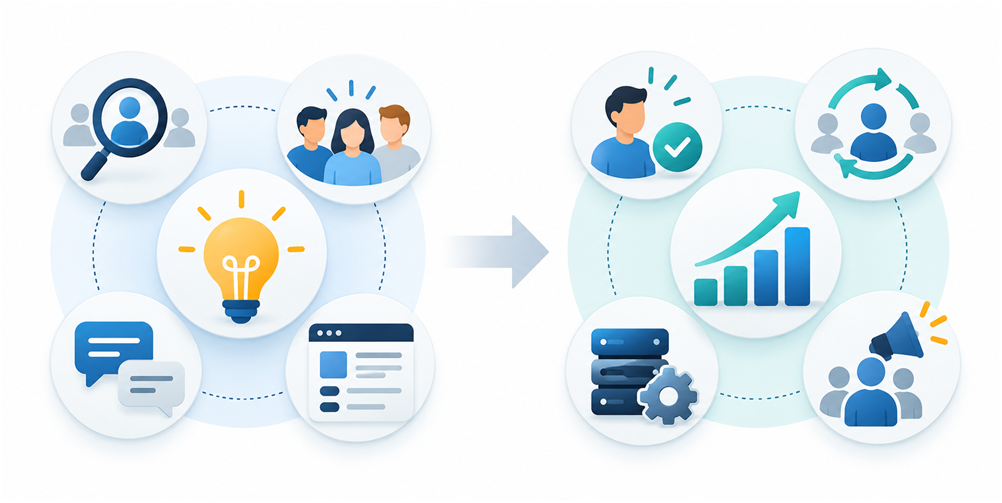
Moving beyond the MVP stage means changing the goal from testing assumptions to building a repeatable business around validated customer demand. The team is no longer asking only whether someone will try the product.
It must learn who receives the most value, why they return, what causes them to leave, and which activities can be repeated without increasing complexity at the same rate as revenue.
| During the MVP stage | During the growth stage |
| Validate the core problem | Deepen repeatable customer value |
| Attract early adopters | Reach a defined ideal customer |
| Collect qualitative feedback | Combine feedback with usage data |
| Build essential features | Improve activation and retention |
| Use manual processes | Automate repeated operations |
| Test willingness to pay | Establish sustainable pricing |
| Fix immediate issues | Improve reliability and scalability |
Growth does not require an early product to become enterprise-ready overnight. It requires the company to remove the most important bottlenecks before those bottlenecks affect more customers.
Founders still deciding how narrowly to define their first product can use CompareCamp’s guide to creating and validating a focused micro SaaS as a useful companion resource.
Caption: The focus shifts from proving the idea to making value, retention, operations, and acquisition repeatable.
1. Confirm That Customers Receive Repeatable Value
A burst of sign-ups can come from curiosity, personal networks, a launch campaign, or a temporary promotion. None of those signals alone proves that a SaaS product is ready for growth. Before increasing marketing spend, founders should establish whether users consistently reach the outcome the product promises.
Look for behaviour that indicates real value:
- New users complete the main onboarding action.
- Customers reach the product’s first meaningful outcome in a reasonable amount of time.
- Users return without being personally reminded by the founding team.
- The core feature is used repeatedly rather than tested once.
- Trial users convert to paid plans and remain after the first billing period.
- Customers recommend the product or invite colleagues to use it.
Quantitative data shows what users do, while conversations help explain why. Interview active customers, users who registered but never activated, customers who cancelled, and prospects who selected another solution.
Ask what they expected, where they became stuck, what result mattered most, and what they would use if the product disappeared. Patterns across these groups are more useful than isolated feature requests.
2. Choose a Small Set of SaaS Growth Metrics
Early teams often track total registrations, page views, or social engagement because those numbers are easy to see. A useful SaaS scorecard should instead show whether customers reach value, pay, stay, and support healthy unit economics.
The aim is not to build a complex executive dashboard. It is to create a shared view of the business that leads to better decisions.
| Metric | Question it answers |
| Activation rate | Do new users experience the core value? |
| Trial-to-paid conversion | Are users willing to pay for that value? |
| Monthly recurring revenue | Is recurring revenue moving in the right direction? |
| Customer churn | How many existing customers are leaving? |
| Net revenue retention | Is revenue from existing customers expanding or shrinking? |
| Customer acquisition cost | How much does it cost to gain a customer? |
| Customer lifetime value | How much economic value does an average customer create? |
| Support volume | Does customer growth create unsustainable service work? |
Stripe’s guide to essential SaaS metrics explains acquisition, engagement, retention, growth, and economic metrics, including churn, net revenue retention, ARR, MRR, CAC, lifetime value, and gross margin. The right benchmark depends on the audience, price, contract length, and product category, so founders should compare their results with their own historical cohorts as well as relevant market benchmarks.
3. Improve Onboarding Before Increasing Acquisition
Sending more traffic into a weak onboarding experience increases acquisition costs without creating durable growth. The first priority is to define the activation event: the action or outcome that shows a new customer has experienced the product’s central value.
For an invoicing product, that might be sending the first invoice. For a collaboration product, it may be creating a workspace and inviting a colleague.
A focused onboarding improvement cycle is simple:
- Define the first meaningful outcome for the target customer.
- Measure how long successful users take to reach it.
- Find the onboarding step with the largest abandonment rate.
- Remove unnecessary setup, explain the next action, or provide a useful template.
- Compare activation for the new cohort with the previous cohort.
Product tours are not a substitute for a clear route to value. Good onboarding reduces decisions, uses sample data when appropriate, and gives help in context. It can also be segmented by role or use case so that customers see the shortest route to the outcome they care about.
4. Make Retention the Foundation of Growth
Acquisition creates the appearance of momentum, but retention determines whether that momentum compounds. If new customers leave as quickly as they arrive, the company must continually replace lost revenue before it can grow. Churn is therefore not only a customer-success problem. It can reveal gaps in onboarding, product value, reliability, pricing, positioning, or support.
Retention is strongly connected to growth: In a study of more than 2,500 SaaS businesses, ChartMogul found that the median company with net revenue retention of at least 100 percent grew 48 percent year over year, about twice as fast as companies in lower NRR ranges. The SaaS Retention Report also shows that retention patterns vary by annual recurring revenue, average revenue per account, and subscriber count.
An early-stage product does not need to force every user to stay. It should identify the customer group that receives the clearest value and learn why that group retains better. The product roadmap, onboarding, support, and marketing can then become more specific to that ideal customer profile.
5. Build the Roadmap Around Customer Outcomes
A growing list of customer requests can make the product roadmap feel urgent but directionless. Treating every request as a commitment creates complexity and makes the product less coherent. A better approach is to evaluate whether a proposed improvement strengthens the main outcome for the target customer.
Evaluate requests using five questions:
- How many target customers experience this problem?
- Would the improvement increase activation, retention, or expansion?
- Does it strengthen the product’s core use case?
- What will it cost to build, operate, support, and maintain?
- What evidence would show that the improvement worked?
Reliability fixes and onboarding improvements may produce more value than a highly visible new feature.
The aim is not to stop experimentation. It is to ensure that experiments are connected to a customer or business outcome and can be evaluated after release.
6. Prepare the Product and Operations for More Customers
An MVP can depend on manual releases, founder-led support, and informal troubleshooting. These methods become risky as more customers depend on the product. Growth-stage operations should make routine work repeatable and give the team enough visibility to find problems before they affect a large share of users.
The practical foundations include:
- Reliable application hosting and repeatable releases
- Monitoring, logs, and error visibility
- Database backups and tested recovery procedures
- Access controls and secure management of credentials
- Clear ownership for incidents and customer communication
- Visibility into usage and cost by customer or tenant where possible
- Documented support and escalation processes
AWS’s Well-Architected SaaS Lens recommends designing and operating SaaS workloads with tenant context in mind. Its guidance includes aligning infrastructure consumption with real tenant activity and making tenant-level usage visible enough to support proactive operations.
CompareCamp’s guide to building and maintaining a cloud-based SaaS application provides additional context on architecture, development, testing, maintenance, and scaling.
Small teams do not need to build every operational workflow themselves. Managed services and automation can reduce repetitive work, but platform selection should consider application support, visibility, scaling needs, operational effort, and long-term cost. A practical review of cloud infrastructure for a growing startup can help teams identify the tradeoffs before usage increases.
7. Create One Repeatable Customer Acquisition System
Early SaaS companies often try search, paid advertising, communities, partnerships, outbound sales, social content, and product-led referrals at the same time. This spreads a small team across too many feedback loops and makes it difficult to learn why a channel succeeds or fails.
A more disciplined acquisition process is:
- Define the ideal customer by problem, context, and buying authority.
- Identify where that audience already searches, learns, or asks for help.
- Select one primary acquisition channel and one clear message.
- Measure qualified leads, conversion, acquisition cost, and payback.
- Improve the channel until it produces useful learning or repeatable results.
- Add a second channel only when the team can operate the first consistently.
The best channel depends on the price, buyer, sales cycle, and complexity of the product. Search-led educational content can compound over time, while founder-led outbound may produce faster conversations for a narrow B2B audience.
CompareCamp’s guide to building a sustainable organic growth strategy explains how content, search intent, and product positioning can work together.
8. Refine Pricing and Packaging With Real Usage Data
Pricing determines what customers pay. Packaging determines which customers receive which combination of value. As usage data accumulates, founders can see which features attract customers, which limits cause upgrades, and which plans create disproportionate support or infrastructure costs.
- Choose a pricing unit that customers associate with value.
- Separate plans according to meaningful differences in customer needs.
- Keep the number of plans understandable.
- Use actual usage patterns before introducing limits.
- Offer annual billing when it fits the buying cycle and cash-flow needs.
- Make upgrade triggers predictable rather than surprising.
- Include support and infrastructure costs in pricing decisions.
9. Expand the Team Where Growth Creates a Bottleneck
More customers do not automatically require a larger team in every function. Hiring should remove a demonstrated constraint. Useful signals include product decisions being delayed because customer research is neglected, support work preventing engineers from improving the product, reliability depending on one person, or qualified sales opportunities being missed consistently.
Document the process and desired outcome before hiring. Otherwise, the company may add people without clarifying ownership or improving throughput.
Automation can also remove operational bottlenecks. For example, when application delivery and infrastructure tasks consume increasing engineering time, an Agentic AI platform for deployment such as Kuberns can help centralize parts of that workflow. The choice should depend on the application’s architecture, operational requirements, and the level of infrastructure control the team needs.
A Practical 90 Day SaaS Growth Plan
The following plan gives an early-stage team a sequence for learning and improvement. The specific actions should be adjusted to the product’s sales cycle and current evidence.
| Period | Primary objective | Actions |
| Days 1 to 30 | Validate the foundation | Interview users, define activation, review churn, identify the strongest customer segment, and establish baseline metrics. |
| Days 31 to 60 | Improve customer value | Simplify onboarding, fix the largest friction point, improve support, and review pricing and packaging. |
| Days 61 to 90 | Build repeatability | Automate recurring operations, test one acquisition channel, document core processes, and establish a monthly metric review. |
Do not scale acquisition yet if activation is unclear, customers leave soon after paying, support problems are increasing faster than the customer base, releases are unreliable, or no customer segment shows consistent usage. In that situation, the best growth investment is usually improving the product and customer experience.
Common Mistakes When Growing Beyond an MVP
- Increasing acquisition before fixing activation. More traffic magnifies an inefficient customer journey.
- Treating every request as a roadmap priority. Prioritize outcomes shared by the target segment.
- Measuring registrations instead of retained customers. Sign-ups do not reveal durable value.
- Hiring before defining the bottleneck. Add a role only when its expected outcome is clear.
- Overengineering for a hypothetical scale. Improve the constraints supported by current evidence.
- Ignoring reliability until customers complain. Monitoring and ownership should grow with dependency.
- Choosing tools only by the lowest introductory price. Include time, maintenance, and operational effort.
- Expanding into several segments simultaneously. Focus produces clearer product and marketing decisions.
Scale the Proven Parts of the Business
A SaaS company grows successfully when it scales verified customer value rather than simply adding features, traffic, employees, or infrastructure.
The sequence matters: confirm that customers receive repeatable value, measure activation and retention, improve onboarding, strengthen operations, establish one repeatable acquisition channel, and expand the team only when a clear bottleneck appears.
The transition from MVP to growth is not a single launch or funding milestone. It is a series of evidence-based improvements that make customer outcomes and business operations more predictable.
When each stage is supported by real usage, customer feedback, and sustainable economics, growth becomes a system the company can improve rather than a short-lived spike it must continually replace.