
Contract security runs on two things: putting the right officer at the right post, and proving afterwards that the post was actually covered. Both sound administrative. Both decide whether a company keeps a contract.
The scale of the problem is easy to underestimate. The US Bureau of Labor Statistics counted 1,304,000 security guard jobs in 2025, at median pay of $18.29 an hour, with the occupation projected to grow about 1 percent through 2035. That is a very large, largely hourly, largely distributed workforce. It is also a workforce that mostly works where its managers are not.
Most guarding firms start out running this on spreadsheets, group chats and phone calls. That works up to a point, usually somewhere between twenty and forty officers. Past it, the administrative load stops scaling and starts breaking things. Guard management software exists to absorb that load in two specific places.
Part one: what scheduling software actually fixes
Scheduling in contract security is not the same problem as scheduling in retail or hospitality. A retail shift that goes uncovered costs a sale. A guard post that goes uncovered can breach a client contract, and in some jurisdictions can breach a licensing condition.
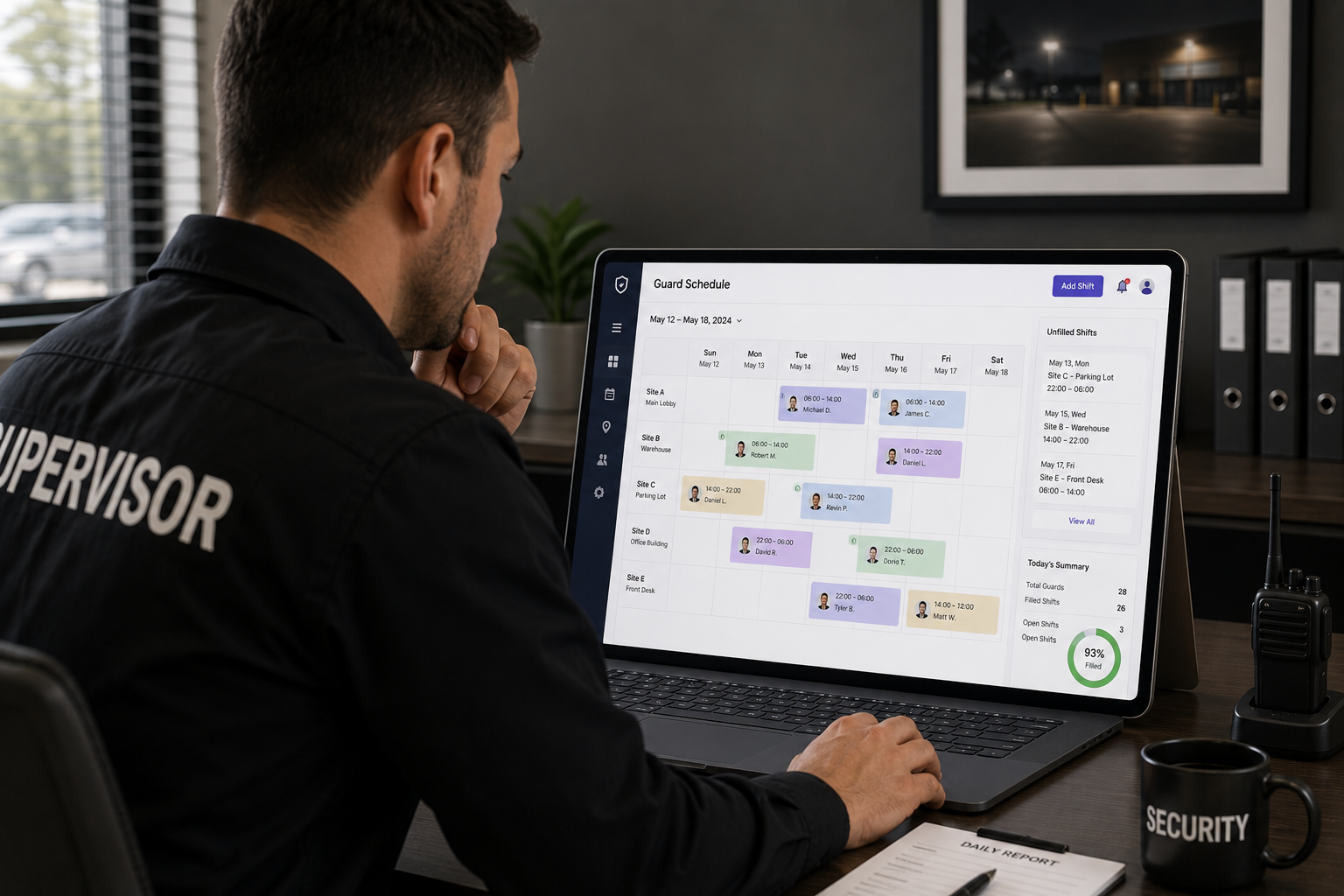
Coverage gaps become visible before they happen. The core function is unglamorous: a single view of every post, every shift and every assigned officer, with the holes showing. Managers working from spreadsheets typically find the hole when the client calls. A scheduling system surfaces an unfilled overnight post days ahead, while there is still time to fill it.
Callouts stop being phone trees. Officer callouts are constant in this industry. Handling one manually means a supervisor ringing down a list, often at 4am. Most platforms replace this with open shift broadcasting: the shift is published to qualified, available officers, and the first to accept takes it. The supervisor approves rather than dials.
Certification matching gets enforced by the system. This is where generic scheduling tools tend to fall down. Guarding has credential requirements that vary by state and by post. California, for example, requires officers to register with the Bureau of Security and Investigative Services and carry a guard card, with separate permits for armed work. A guard management platform stores each officer’s licenses and expiry dates and blocks anyone uncertified or lapsed from being scheduled at all. Compliance moves from something a manager remembers to something the software refuses to let you get wrong.
Overtime becomes a decision rather than a discovery. Overtime is one of the largest controllable costs in guarding, and the rules are not optional. Under the Fair Labor Standards Act, covered non-exempt employees must receive overtime at not less than one and a half times the regular rate for hours worked beyond 40 in a workweek. Software that shows projected weekly hours as the schedule is being built lets a manager see the overtime coming and reassign before it lands. Spreadsheets show it after payroll has run.
Time capture stops being a trust exercise. Paper timesheets and text-message check-ins are difficult to audit and difficult to defend. Geofenced mobile clock-in ties the punch to a location and a timestamp. That matters beyond payroll accuracy, because the FLSA also carries recordkeeping obligations covering hours worked and wages paid, and an auditable digital record is considerably easier to produce than a box of paper.
Buyers comparing the general category will find broad roundups useful for orientation, such as CompareCamp’s list of scheduling software options, though guarding-specific requirements like license gating rarely appear in general-purpose tools.
Part two: what patrol tracking actually proves
Scheduling answers whether an officer was assigned. Patrol tracking answers whether the site was walked. These are different claims, and clients increasingly want evidence for the second.
Checkpoint scanning replaces the assertion with a record. The common implementation is a set of NFC tags or QR codes fixed at defined points around a site. The officer scans each one on the mobile app as they reach it, producing a timestamped record of where they were and when. It is a small mechanism with a large effect: patrol completion becomes data rather than an officer’s word against a client’s suspicion.
Missed checkpoints trigger alerts instead of surfacing later. A tour that should have been completed by 2am and was not can page a supervisor at 2:05. Handled well, this is a coaching and coverage tool. Handled badly, it becomes surveillance theater that officers resent, which is worth being deliberate about.
GPS establishes patrol routes and vehicle movement. For mobile patrol accounts covering multiple sites per shift, location history answers the question clients ask most: how long were you actually on my property. Note that GPS tracking of staff carries genuine privacy considerations and, in some jurisdictions, notice and consent obligations. Companies deploying it should be explicit with officers about what is tracked, when, and why. The employee monitoring category has its own tooling and its own debates, which CompareCamp covers separately in its employee monitoring software roundup. Firms running a patrol fleet usually end up assessing vehicle tracking alongside officer tracking, where CompareCamp’s fleet management software roundup is the closer fit.
Incident reporting moves into the same record. When an officer files an incident from the same app that logged their patrol, the report arrives with location, timestamp and often photographs attached, rather than being reconstructed from memory at the end of a shift. The quality difference is substantial, and it is the material clients and insurers actually read.
Where the two halves connect
The reason these functions sit in one platform rather than two is that the useful questions cross between them.
Which posts generate the most missed checkpoints, and are they the posts staffed by whoever was available rather than whoever was suited? Which officers consistently complete tours on time, and are they being scheduled onto the difficult accounts or the easy ones? Is the overnight shift at a particular site chronically thin because of scheduling, or because the patrol route was designed for a smaller building?
None of those are answerable if scheduling data and patrol data live in different systems. A platform that covers employee scheduling and checkpoint tours against the same officer and site records can report across both.
Broader workforce platforms approach the same ground from the other direction, adding field capability to a general scheduling core. Firms weighing one of those against a guarding-specific system should test the credential handling and post-order detail closely, because that is usually where the two categories separate.
What this does not solve
Software will not fix a bad post order, an underpriced contract or a supervisor who does not follow up on alerts. Nor does it reduce headcount. Every function described here changes what administrators and officers spend their time on. None of it removes the requirement to have a licensed human at the post.
It is also worth being realistic about adoption. These systems live or die on whether officers actually use the mobile app. A platform with excellent back-office reporting and an app that officers find slow or confusing will produce incomplete data, and incomplete data is worse than none because it looks authoritative. Any evaluation should include putting the officer-facing app in front of actual officers before signing.
The practical takeaway
Scheduling software reduces the two costs that quietly erode margin in contract security: uncovered posts and unplanned overtime. Patrol tracking reduces the two disputes that cost contracts: whether the site was covered, and what happened when something went wrong.
Firms running fewer than roughly twenty officers can often manage both on spreadsheets and attention. Past that, the question stops being whether to systematize and becomes which system, and how much of the guarding-specific detail it genuinely handles.