
Sales, marketing, and service are all orchestrated based on the CRM. By analyzing historical and customer data, businesses can enhance loyalty, predict sales, and effectively manage relationships. IoT, on the other hand, redefines interactions between humans, machines, and devices. In other words, it generates streams of live data about consumption, performance, and conditions.
When isolated, these two systems act completely differently. But once converged, they bring broader, unrestricted visibility into real-time anomalies, customer usage, and contextual behavior. That’s why it’s pivotal to learn more about the role IoT sensors and devices will play in enhancing the capabilities of next-gen CRM systems.
How IoT Integrates With CRM Systems?
Integrating IoT with CRM isn’t merely about plumbing data pipes into an existing framework. Rather, it’s about orchestrating action triggers, insights, and workflows with precision and accuracy. Below, we have provided a streamlined functional flow between these two systems.
#1 Data ingestion layer
At this stage, IoT data collection commences. This ensures real-time device insights can seamlessly reach the CRM systems efficiently.
- Sensors and gateways collect multifarious forms of telemetry, like location, usage, and health records.
- Data is then transmitted via edge or cloud platforms, like Azure IoT Hub or AWS IoT.
- Preprocessing, cleaning, filtering, and normalizing are then executed to maintain relevance and quality.
#2 CRM integration & enrichment
The cleaned, pre-processed data is then merged with the CRM customer profiles to offer businesses a deeper context.
- Every device is accurately mapped with a product, customer, or account within the CRM.
- Real-time updates add more value to the customer records by offering live product usage metrics.
- Automation triggers regular workflows, including upsell offers, service alerts, and maintenance tickets.
#3 Feedback & action loop
With this, the data cycle closes as insights are translated into potential actions.
- CRM leverages IoT data to initiate service tasks or send proactive messages.
- Customer interactions and the corresponding outcomes are fed back to the system.
- Continuous learning enhances future engagement strategies and improves prediction accuracy.
Benefits of IoT Transformation in CRM Software Solution
The convergence of IoT and CRM brings stellar benefits to the table across customer experience, operations, and business insights. Here’s what they look like.
Proactive and predictive service
IoT-enabled CRMs are capable of anticipating potential issues before they come to the attention of the customers. This helps improve reliability and cut off the risks of increased downtime.
According to a recent study from Deloitte, sensor-driven predictive maintenance can reduce unplanned downtime by up to 25%.
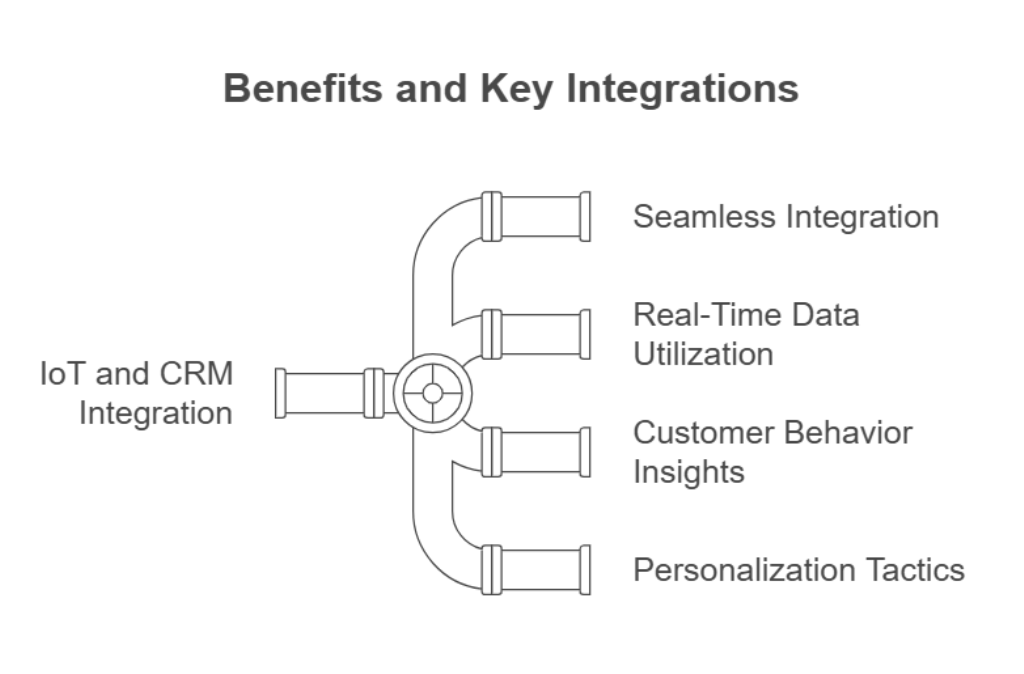
Real-time device data automatically triggers alerts and mapped service actions. Hence, companies can work on faster resolutions and deliver a stellar customer experience.
Contextual and hyper-personalized engagement
Merging IoT data with CRM insights will transform user engagement completely. Businesses can leverage the outcomes to deliver a hyper-personalized experience that caters to customers’ real-time needs. Here are a few examples to understand this aspect better.
- Service or product recommendations based on live device usage.
- Timely offers or reminders once usage thresholds are met.
- Timing and communication tone aligned to customer behavior and preferences.Improved operational efficiency
The latest report highlights that the IoT market is forecasted to achieve a whopping valuation of $1115.72 billion by 2029.
Given this number, it’s evident that integrating IoT data with the CRM framework will help businesses improve their operational efficiency. Elimination of manual processes will improve the accuracy and streamline resource allocation. To top it off, data synchronization and automated alerts will foster faster response time and reduced waste generation.
Deeper analytics & business intelligence
IoT-powered CRM systems merge operational and behavioral metrics. With this, businesses can seamlessly access powerful data-driven insights. Here’s how!
- Forecast trends by analyzing real-time customer interactions
- Refine support and design workflows based on product usage anomalies.
- Monitor KPIs dynamically through data visualization dashboards.Enhanced customer satisfaction & retention
When CRM and IoT work together, companies can personalize interactions, respond proactively, and prevent issues from escalating. Thanks to this, they can strengthen customer relationships and improve brand loyalty With the help of cross platform mobile app development services you can further enhance these efforts, allowing businesses to deliver personalized experiences across various devices and platforms.
The Role of IoT in Next-Generation CRM System
Current CRM systems do not support automatic data capture. Around 32% of sales representatives emphasized that they have to spend more than an hour to enter data manually into the application. This is where IoT integration comes into the picture! It adds a real-time sensory layer, translating realities into actionable signals. With an AI Ad Maker, businesses can complement these insights by crafting personalized, data-driven ads that resonate with customer behavior in real time.
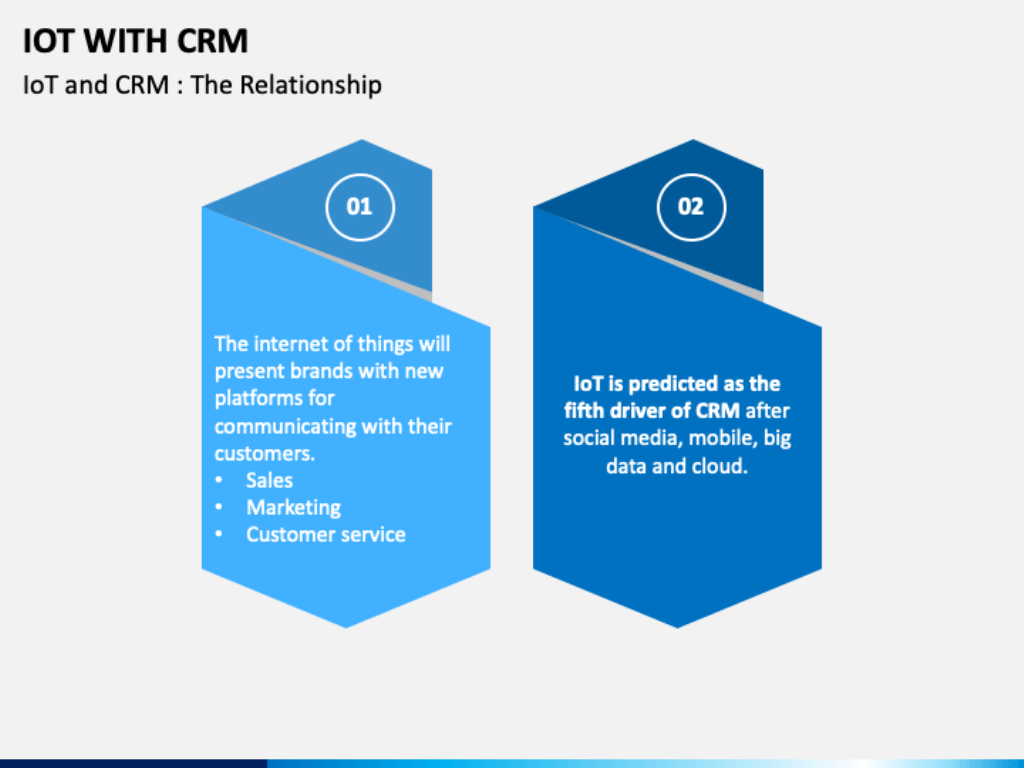
Below is a brief overview of what key roles IoT data will play in boosting the performance of next-gen CRMs.
- The platform will remain updated about live device usage, states, and anomalies.
- IoT events will initiate actions programmatically, be it triggering an upsell journey or notifying a customer about an upcoming offer.
- Device outcomes and customer feedback can be fed back to the system for further performance refinement.
- Interventions, offers, and content can adapt dynamically to the actual usage metrics fed from IoT sensors and devices.
Best Practices for IoT Integration with CRM
Technical plumbing alone won’t suffice for a successful convergence of CRM and IoT. Instead, businesses should emphasize data discipline, architectural foresight, and workflow alignment.
That being said, below are the best practices that can be adopted to facilitate this technical merger.
#1. Starting with pilot projects
Begin with a limited use case; a single product line or one application area (like predictive maintenance). With this, businesses can validate workflows, data integration, and ROI before scaling the connected system.
#2. Establishing clear data mapping and ownership
IoT telemetry mapping with CRM entities should be mapped properly. Ownership of data fields should be clearly planned. In addition, the schema and naming conventions should be consistent across both IoT and CRM systems.
#3. Using middleware or IoT platforms for mediation
Message brokers, streaming platforms, or API gateways will decouple IoT device evolution from any form of CRM changes. Hence, flexibility will improve significantly by several notches.
#4. Emphasizing data quality, filtering, & aggregation
Redundant data will automatically overwhelm both systems. That’s why businesses should put proper threshold rules in place for smoothing, planning, and aggregation.
#5. Incorporating security, privacy, and compliance by design
Secure authentication, military-grade encryption protocols, and role-based access control should be designed for IoT-enhanced CRM systems. Equally important, organizations must implement robust data security measures to protect sensitive customer information as IoT devices continuously exchange real-time data with CRM platforms.
Real-World IoT Applications in CRM
IoT-driven CRM systems have already started transforming customer engagement across industries. Businesses can now leverage automated workflows and real-time metrics to make the right calls. The following real-world examples will help you further understand why this technological convergence is a game-changer.
- Tesla cars are designed to send real-time diagnostics to the CRM, thereby triggering predictive maintenance reminders.
- Siemens leverages IoT alerts in CRM for predictive equipment servicing.
- Fitbit integrates with CRM to deliver personalized recommendations about health and fitness.
- Philips Hue capitalizes on IoT data to monitor device health and automate warranty claims.
The Future of IoT in CRM
A report from Statista reveals that the CRM global market will reach a total volume of $145.37 billion by 2030.
Given this, we can envision a futuristic image where IoT, automation, and AI will lay the cornerstone for connected ecosystems. The next-gen CRM systems will evolve into real-time engagement platforms. With this, businesses can create action strategies based on customer needs.
Conclusion
Integrating IoT devices and sensors with CRM systems will redefine how businesses interact with their customers. In other words, core operations, like sales and marketing, will shift from being static to dynamic, from reaction to prediction, and from generic to context-aware. With real-time trigger systems and enriched data insights, companies can deliver a richer experience and gain competitive differentiation.