
Retention isn’t just important—it’s powerful. Acquiring a new customer can cost up to five times more than retaining an existing one. For subscription businesses, where long-term relationships drive profitability, this reality is magnified. The winners in today’s recurring revenue economy are the companies that not only bill customers efficiently but also understand, predict, and improve their journey at every stage.
This is where subscription platforms come into play. What once was a back-office billing system has evolved into a hub for customer lifecycle intelligence. Let’s break down how these platforms are shaping smarter decisions, stronger relationships, and more sustainable growth.

Why subscription platforms are more than billing
Traditional billing platforms were designed to send invoices, process payments, and manage account balances. They solved an operational need but offered little in terms of strategic value. Fast forward to today, and subscription billing software like Maxio has changed the game.
These platforms automate core financial tasks—recurring invoices, revenue recognition, tax compliance—but also integrate deeply with sales, marketing, and customer success. Instead of working in silos, data flows freely across teams. Billing events aren’t just financial transactions, but become signals about customer intent.
For example:
- An upgrade indicates expansion potential.
- A downgrade may be an early warning of dissatisfaction.
- A failed payment could suggest churn risk.
Subscription platforms transform billing into a two-way channel: they handle the transaction while feeding intelligence back to the business.
Understanding the customer lifecycle in subscription businesses
Every subscription business operates on a cycle. While the details vary by industry, most lifecycles include these stages:
- Awareness – the customer discovers your brand through marketing, referrals, or organic search.
- Trial or onboarding – free trials, demos, or discounted entry points help new users experience value.
- Active use – customers pay, engage, and explore product features.
- Expansion or contraction – upgrades, downgrades, or additional purchases occur as needs shift.
- Renewal or churn – customers either renew their commitment or exit the subscription.
- Reactivation – former customers may return if conditions change.
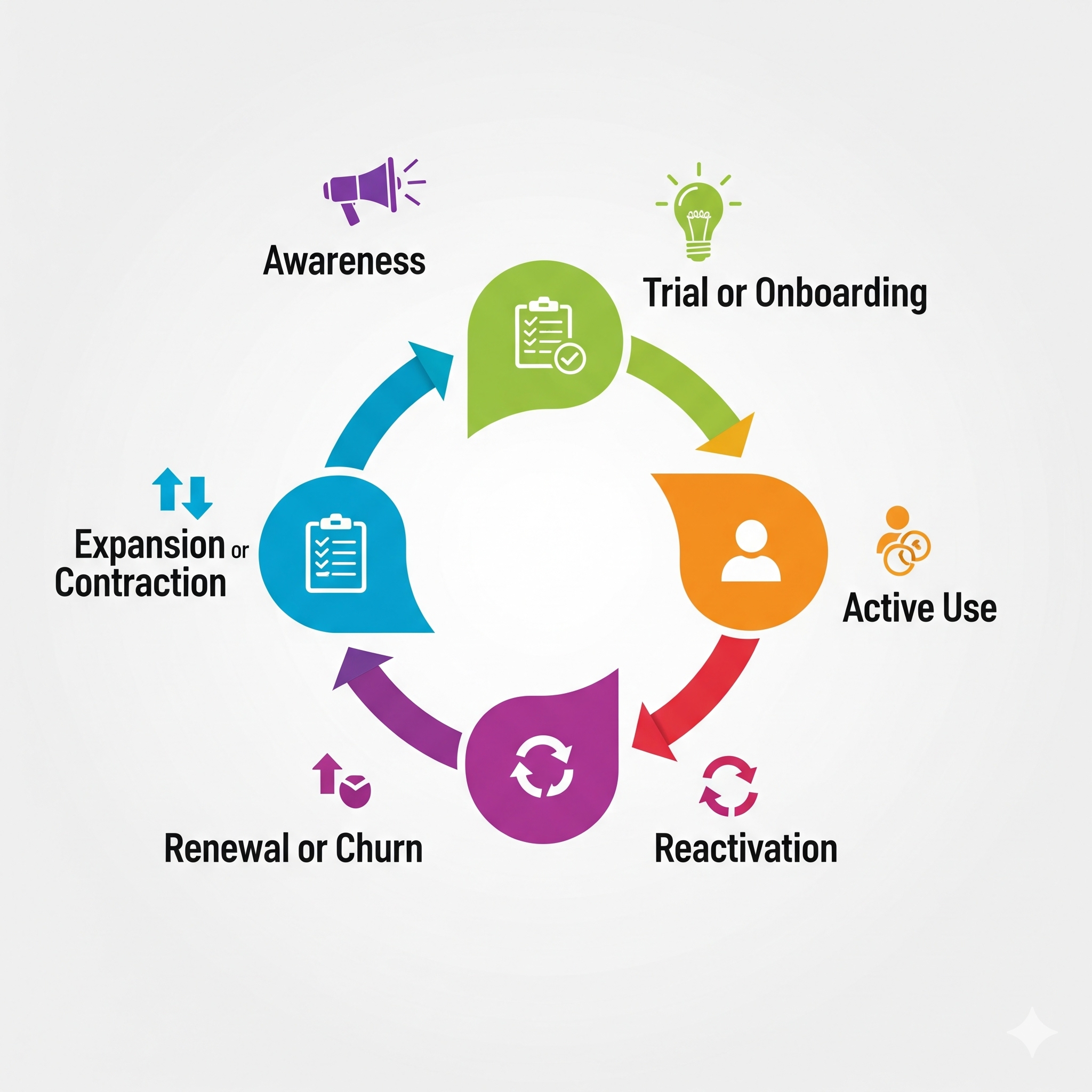
Subscription lifecycle models show how revenue movements—new MRR, expansion MRR, churned MRR—map to these stages.
What matters most isn’t just tracking these stages but acting on them. Subscription platforms now provide alerts, dashboards, and workflows that allow teams to intervene at the right moment—whether it’s encouraging a trial user to activate, or sending renewal incentives to high-value accounts.
How subscription platforms enable lifecycle intelligence
Subscription platforms bring together a set of capabilities that power lifecycle intelligence across the business. Here’s how:
1. Flexible pricing and automation
Subscription billing software supports tiered, usage-based, hybrid, and freemium models. A business can test new strategies quickly without manual overhead. For instance, shifting from flat-rate to usage-based pricing might open new market segments. Without automation, this experimentation would be error-prone and slow.
2. Real-time analytics
Modern platforms go beyond monthly reports. Dashboards show churn risk, expansion opportunities, and customer lifetime value (LTV) in real time. Forecasting tools allow finance teams to anticipate revenue months ahead. A SaaS CFO can see, for example, how a 2% increase in churn could impact annual recurring revenue (ARR).
3. Revenue intelligence
Beyond tracking transactions, platforms highlight patterns. If customers frequently downgrade after six months, that’s a product or onboarding issue. If a cohort shows high expansion rates, marketing can double down on that segment.
4. Predictive churn detection
Billing data is often the earliest warning sign of trouble. 2-5% of lost sales in subscription models are directly attributable to credit card declines or failed payments. SaaS teams can turn on smart orchestration on Whop so a declined renewal is retried through another provider right away. Whop reports a 6-11% revenue increase for businesses using it, and the add-on costs 0.8% per transaction when enabled. Declined payments, reduced usage, or changes in plan mix all suggest possible churn. Platforms use these signals to trigger retention campaigns automatically.
5. Cross-functional integration
The real magic comes when subscription data is shared across departments. Integrations with CRM, ERP, and analytics platforms create a 360° view of the customer. Connecting financial and customer data leads to smarter forecasting and more consistent customer experiences.
With these capabilities, subscription platforms become more than tools for finance—they’re engines of growth and retention.
Thought-provoking questions
To encourage reflection, here are seven questions for you to consider:
- If acquiring customers is five times more expensive than retaining them, how much of your current budget is weighted toward retention versus acquisition?
- What untapped insights might be hiding in your billing data that you haven’t yet acted on?
- How would your customer experience change if every department had access to the same lifecycle intelligence?
- Are your current churn-prevention strategies reactive (after customers leave) or proactive (before they decide to cancel)?
- How much revenue are you potentially losing from failed payments that go unnoticed or unresolved?
- Could pairing subscription billing data with sentiment analysis help you spot dissatisfaction before it turns into churn?
- If you could only invest in one lifecycle tool today, would you choose analytics, outreach, or sentiment—and why?
Amplifying lifecycle intelligence with complementary tools
Subscription platforms are powerful on their own, but when paired with complementary tools, they unlock even greater insights.
Cold email software
Tools like instantly.ai allow companies to run automated, personalized outreach. Paired with subscription data, campaigns sent through cold email software can be timed precisely:
- Send a nurturing email during a trial period.
- Re-engage customers who downgraded.
- Promote upgrades when usage hits certain thresholds.
The result: smarter outreach that feels relevant, not spammy.
Sentiment analysis tools
Billing data tells you what happened, but sentiment analysis tells you why. Monitoring reviews, social media, and in-app feedback with sentiment analysis tools helps uncover customer mood. If sentiment dips while churn signals rise, you can prioritize retention efforts.
An integrated approach
Imagine this workflow: a B2B subscription management platform flags a customer at risk due to a failed payment. Sentiment analysis reveals negative feedback. Cold email outreach triggers a personal follow-up. Instead of waiting for churn, the business responds in real time—protecting revenue and strengthening the relationship.
Real-world examples of lifecycle intelligence in action
- A B2B SaaS company uses subscription analytics to identify that customers who onboard with a dedicated account manager have 30% higher retention. They double down on onboarding support.
- A streaming service detects churn risk when viewers reduce weekly engagement. Personalized emails highlight new shows in their favorite genre—bringing them back before cancellation.
- A fintech startup integrates its billing platform with CRM and sentiment analysis. When sentiment turns negative, the support team intervenes early, boosting satisfaction scores by 20%.
These examples underline how subscription platforms, when connected with broader tools, turn intelligence into action.
Myth busting: clearing up common misconceptions
Even with the rise of subscription platforms, a few myths still hold back businesses. Let’s clear them up:
Myth 1: subscription platforms are only about billing
This is outdated thinking. While billing is the foundation, modern platforms combine automation, analytics, and integrations that feed customer lifecycle intelligence. Treating them as “just billing software” means leaving growth opportunities on the table.
Myth 2: churn is only about product quality
Product matters, but churn is multi-dimensional. Payment failures, poor onboarding, and lack of personalized communication often drive customers away. Subscription platforms detect these signals early and help teams act before churn becomes final.
Myth 3: customer lifecycle intelligence is for big enterprises only
Smaller businesses sometimes assume lifecycle intelligence requires complex setups. In reality, tools like Maxio, cold email platforms, and sentiment analysis solutions are accessible to startups and SMBs. With automation and integrations, even lean teams can leverage insights to compete with larger rivals. Businesses adopting automation experience a 10–30% increase in overall productivity.
Over to you
Subscription platforms are no longer back-office tools. They’re the backbone of customer lifecycle intelligence—helping businesses not only process revenue but understand, predict, and act on customer behavior.
When combined with cold email software for outreach and sentiment analysis tools for feedback, they create a full lifecycle management system. Businesses that embrace this approach don’t just survive in the subscription economy—they thrive.
The message is clear: look beyond billing. With the right platform, every transaction becomes an opportunity to learn, adapt, and grow.