
Legal operations is one of the fastest-growing corners of the profession. And the job description is being rewritten in real time by AI. If you are a law student or early-career professional eyeing the field, the skills that matter most in 2026 look very different from what a contracts class ever prepared you for.

What if you could automate everything?
That was the question that opened the CLOC Global Institute this year. The keynote, delivered by a former OpenAI executive, asked the room to imagine a world where agentic AI could handle most of the routine work we do today, right down to assembling the weekly grocery list. The provocative follow-up was the one that lingered: if everything can be automated, what do you choose to leave in, and what do you leave out? (Above the Law)
For legal operations, that question cuts especially deep. The discipline exists to bring a business lens to legal work — visibility, speed, quality, and cost. Those are exactly the goals automation is now good at hitting. The paradox for anyone entering the field is obvious: master the tools that deliver efficiency, and you risk automating away the very tasks that used to define the job. The opportunity is just as obvious. The people who learn to direct that automation rather than compete with it are the ones writing their own job descriptions.
A genuine inflection point
Legal ops leaders are not shy about the moment they are in. “Going back to the beginning of time, the hardest part of this job has been change management,” Mary O’Carroll, who helped pioneer the field more than two decades ago by finding efficiencies across Google’s 1,500-person legal team, told Law.com, describing a sector she believes is only getting started.
The field has matured from a back-office support function into a recognized career path; the community that once focused on technical training is now coaching members on executive presence and competing for leadership posts.
For a law student, the takeaway is that legal ops is no longer a consolation prize for people who didn’t want to practice. It is a strategic seat, and it rewards a blend of legal fluency, business sense, and software skills that graduates don’t learn in law school. To understand the shape of the role, it helps to start with the building blocks of modern legal operations.
The new mandate: Show the money
If there is one phrase that captures what employers now expect from legal ops, it is this: prove the value. The new AI mandate is actually an old-school metric: show the money. Return on investment has to be expressed in the language the business actually speaks.
This reframes which software skills matter. It is no longer enough to operate a tool. You have to connect what the tool does to a number a finance leader cares about — cycle time, cost avoided, revenue protected.
AI capability ≠ productivity
Here is the trap waiting for the over-eager automator: a more capable model does not automatically make a team more productive. Generative AI accelerates the first draft, but it shifts the work downstream to review. And the review is not free.
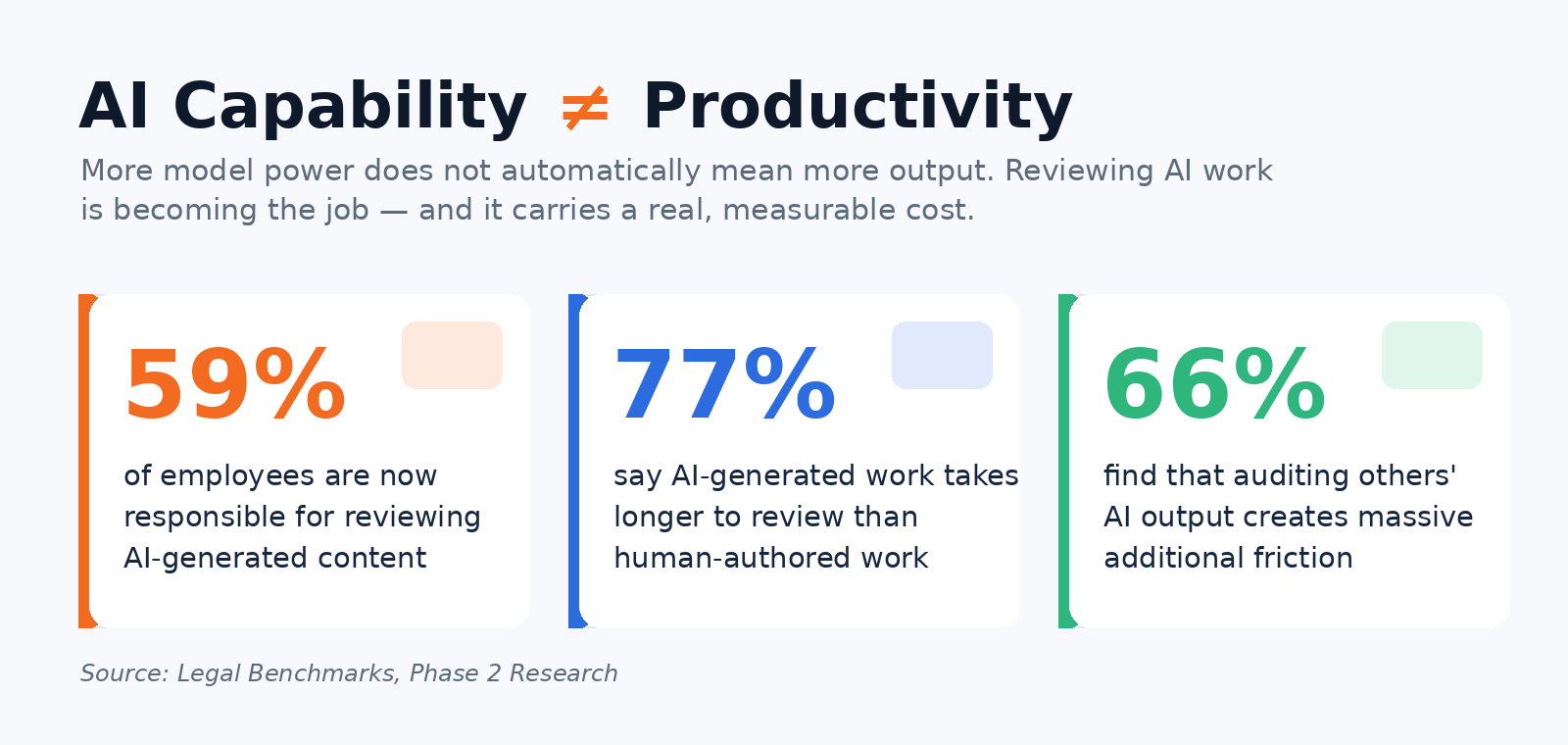
Reviewing AI work is becoming a job that carries a measurable cost.
Recent benchmarking found that 59% of employees are now responsible for reviewing AI-generated content, two of these three reviewers say that work takes longer to review than human-authored work, and 66% find that auditing someone else’s AI output creates substantial additional friction. AI capability, in other words, is not the same as productivity. The teams that win are the ones that close that gap.
The quality problem everyone is fighting
The legal world has a word for the byproduct of careless automation: workslop. “Workslop” is a recognized 2025 term for low-value AI output. Linking its origin to the first use would strengthen credibility for readers new to the term. It’s basically hollow, AI-generated content that looks like good work but lacks the contextual legal logic to actually be good. The danger is that a polished draft hides a fatal error, and the cost of catching it falls on a human reviewer.
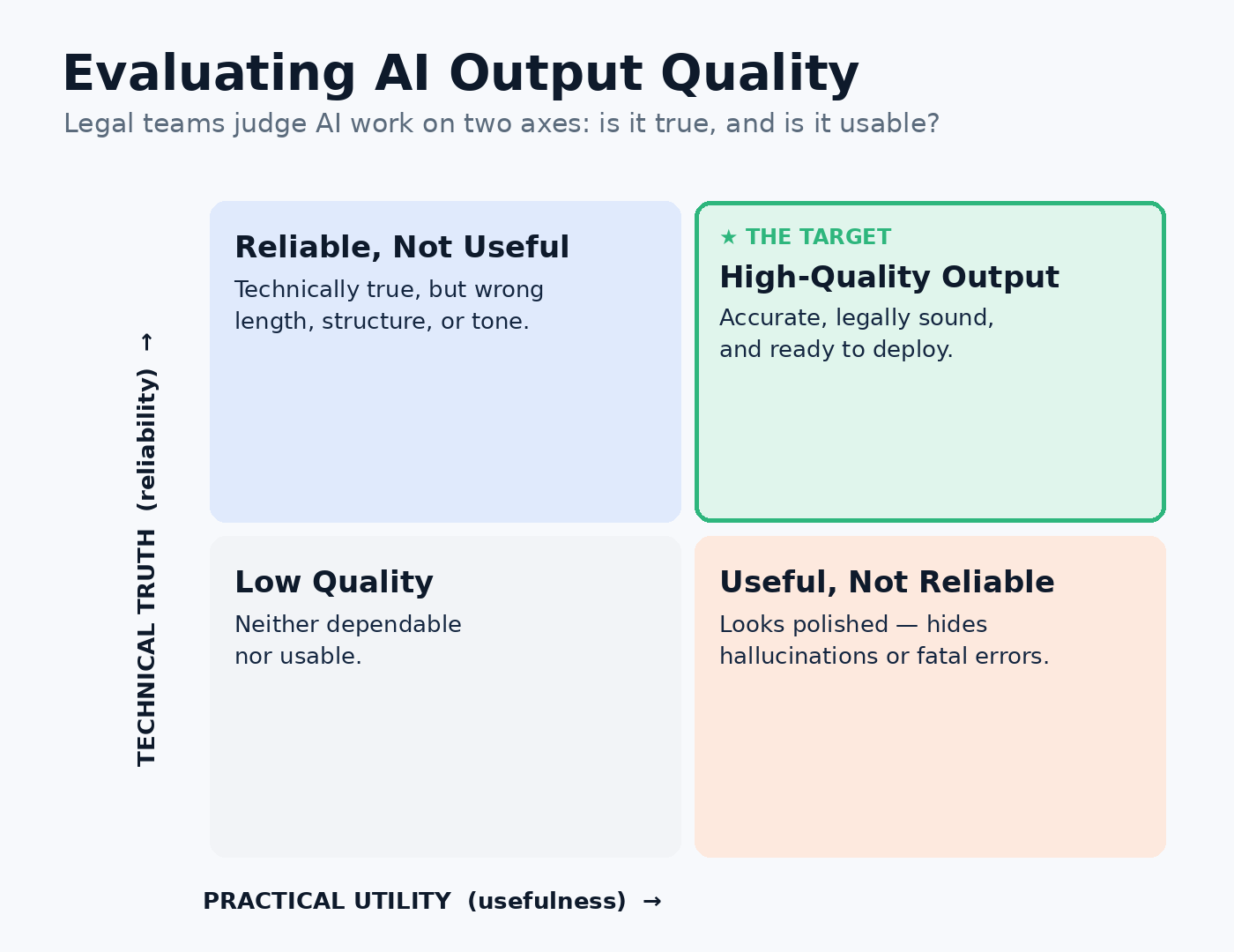
Reliable but unusable, or usable but unreliable?
A useful way to think about it is a simple two-by-two. On one axis is technical truth (is the output reliable?); on the other is practical utility (is it actually usable?). Output that is reliable but not useful is technically correct in the wrong format. Output that is useful but not reliable looks deployable but conceals hallucinations. The target: accurate, legally sound, and ready to use, sits in one corner, and getting there consistently is the whole game.
Remedies
The strongest legal ops teams do three things.
- First, they offload the structured, repeated work to AI, scanning against predefined playbooks, fallback positions, and recurring boilerplate, while reserving judgment and accountability for the lawyers.
- Second, they build guardrails so the machine knows when to escalate.
- Third, they keep a human firmly in the loop, because legal accountability cannot be outsourced to a model.
For early-career professionals, the implication is concrete: knowing how to design and run that review pipeline in legal automation is now a hireable skill.
The skills that actually matter (lessons from DevOps and DesignOps)
Legal ops is not the first discipline to turn craft into a system. Software engineering did it with DevOps, pairing automation, continuous delivery, and observability so teams could ship faster without breaking things. Design teams did it with DesignOps, systematizing tooling and workflow so creative work could scale. Legal ops is now having its own “Oops” (pun intended) moment, and the skill stack borrows directly from those playbooks.
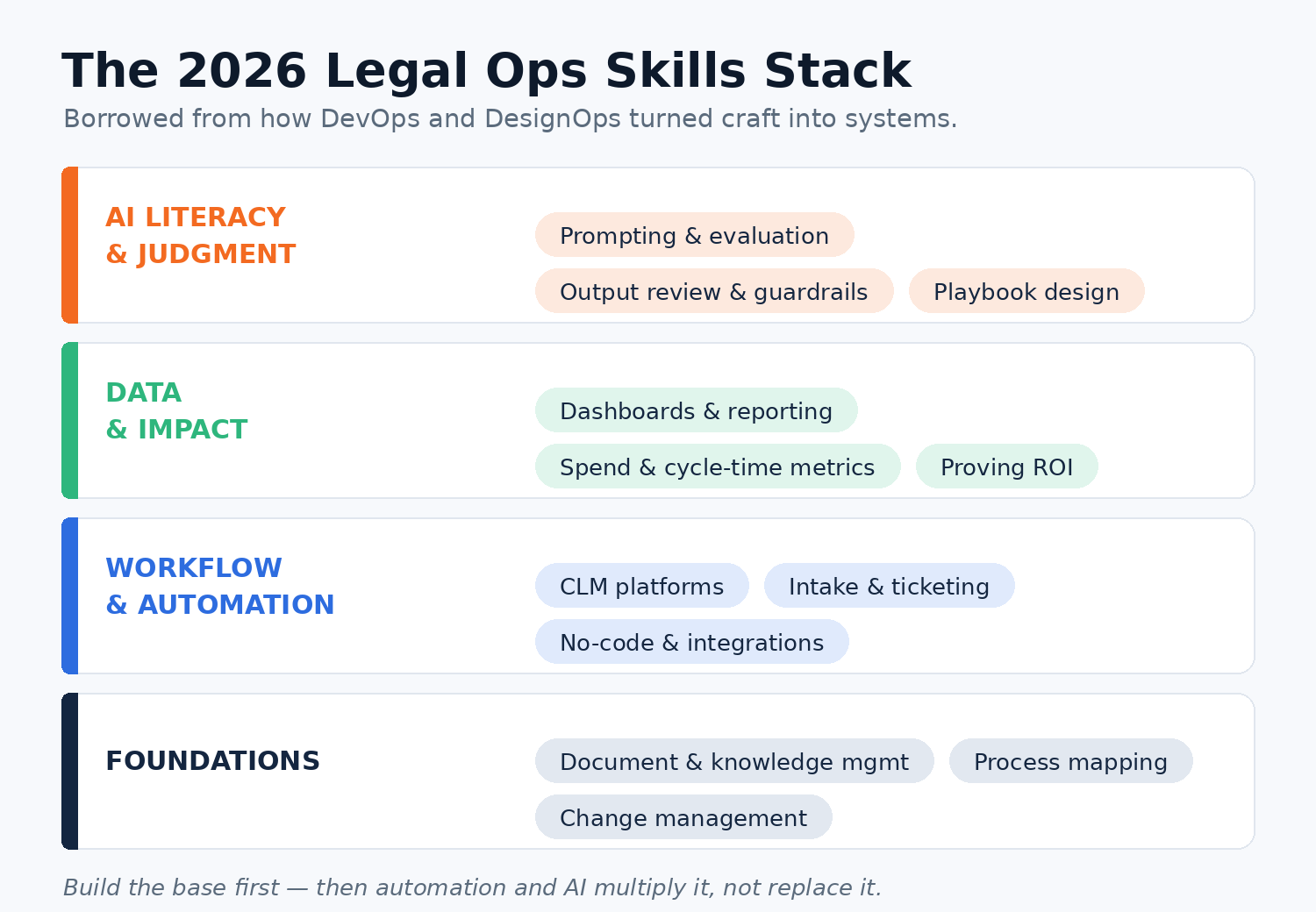
Foundations, process, skills, and then automation.
Start at the foundation. Document and knowledge management, process mapping, change management, and plain collaboration are unglamorous but non-negotiable. CompareCamp’s primer on document management software is a sensible place to understand the category.
On top of that sits the workflow-and-automation layer: contract lifecycle management (CLM) platforms, intake and ticketing systems, no-code automation, and the integrations that wire legal tools into Salesforce, Slack, and Teams. CompareCamp’s roundup of legal software trends is worth reading to see where these categories are heading: AI assistants, workflow automation, cloud platforms, and RegTech, among them.
Above that is the data-and-impact layer: dashboards, spend, and cycle-time metrics, and the ability to prove ROI to a CFO. At the top is AI literacy and judgment: prompting, output evaluation, playbook design, and the discernment to know what should never be automated at all. Employers want exactly this blend. CompareCamp’s look at the competitive skills employers want describes the same shape: hard technical skills layered with soft skills like communication and leadership.
So, what if you could automate everything?
Back to the opening question. The honest answer, for a law student stepping into legal ops in 2026, is that you should automate everything you can, and then spend your career on what’s left.
The rote work is going to the agents. What remains is the work that defines the role: framing the problem, managing the change, vetting the output, and translating all of it into business impact.
Technical fluency gets you in the room, judgment keeps you there. The graduates who internalize that won’t be automated out of a job. They’ll be the ones deciding “what to leave in and what to leave out.”